Direct Particle Interaction Theory
of Schwarzschild, Tetrode and Fokker
DPI is built out of time-symmetric interactions.
At any one time, if there are \(N\) particles mutually visible to each other, then each particle is subject to \(2*(N-1)\) such interactions; \(N-1\) rather then \(N\) if self-action is excluded. And the factor 2 is because interaction is both forwards and backwards in time.
If there are just two particles then at some fixed time (here \(t = 0\)) their interaction can be depicted as below.
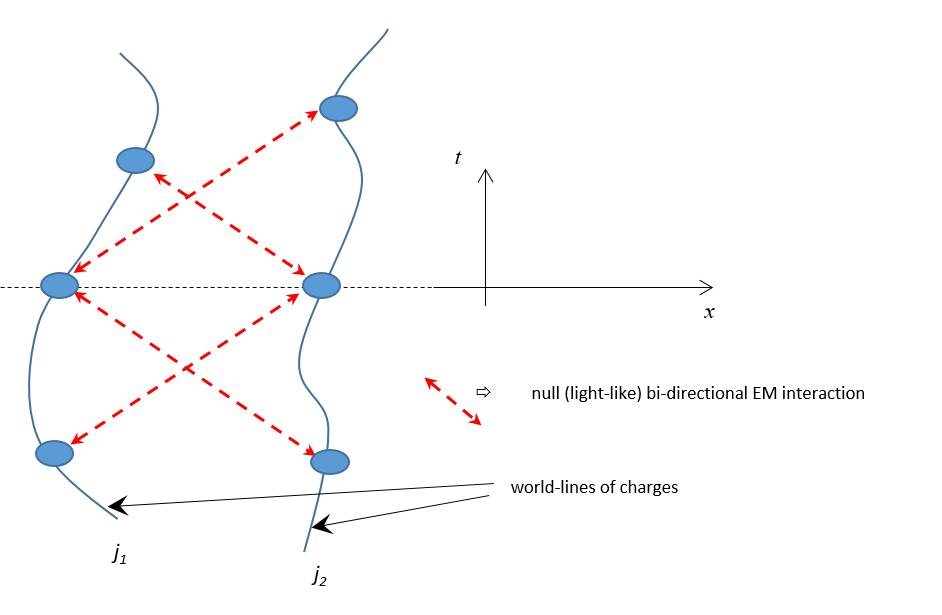
A very brief mathematical expression of the foundation of the classical STF DPI is as follows:
We use the shorthand
\[a \circ b = {a^\mu }{b_\mu },\quad {\left( a \right)^2} = {a^\mu }{a_\mu }\,.\]
Let
\[{q_{\left( i \right)}}\left( \lambda \right) \equiv \left\{ {q_{\left( i \right)}^\mu \left( \lambda \right)} \right\} = \left( {q_{\left( i \right)}^0\left( \lambda \right),q_{\left( i \right)}^1\left( \lambda \right),q_{\left( i \right)}^2\left( \lambda \right),q_{\left( i \right)}^3\left( \lambda \right)} \right)\]
be the world-line of a charge with label \(i\), mass \({{m_i}}\), and charge \({e_i} = {\sigma _i}\left| e \right|\) where \({\sigma _i} = \pm 1\). Then the classical DPI action of Schwarzschild, Tetrode, and Fokker can be written
\[{I_{STF}} = {I_{mass}} + {I_{DPI}}\]
where
\[{I_{mass}} = - \sum\limits_{i = 1}^N {{m_i}\int\limits_{{\mathrm{d}_{\left( i \right)}}\left( {-\infty}\right)}^{{q_{\left( i \right)}}\left( \infty \right)} {\sqrt {{{\left( {d{q_{\left( i \right)}}} \right)}^2}} } } \]
and where
\[{I_{DPI}} = - \frac{{{e^2}}}{{4\pi }}\sum\limits_{i \ne j = 1}^N {{\sigma _i}{\sigma _j}\left[ {\int\limits_{{q_{\left( i \right)}}\left( {-\infty} \right)}^{{q_{\left( i \right)}}\left( \infty \right)} {\mathrm{d}{q_{\left( i \right)}}} \circ \int\limits_{{q_{\left( j \right)}}\left( {-\infty} \right)}^{{q_{\left( j \right)}}\left( \infty \right)} {\mathrm{d}{q_{\left( j \right)}}} } \right]\delta \left( {{{\left( {{q_{\left( i \right)}} - {q_{\left( j \right)}}} \right)}^2}} \right)} \]
where \(\delta\left(\right)\) is the Dirac delta function; \({\delta \left( {{{\left( {{q_{\left( i \right)}}\left( t \right) - {q_{\left( j \right)}}\left( {t'} \right)} \right)}^2}} \right)}\) enforces the constraint that interaction is along light-like connections between each charge pair, as illustrated by the dotted red lines in the figure above. Note, though a Minkowski space-time metric is employed, there is no reference to space-time coordinates.